Geothermal will always work better than air and water source heat pumps for hospitals – here’s why.
Posted on Sunday, November 30th, 2025
Posted on Sunday, November 30th, 2025
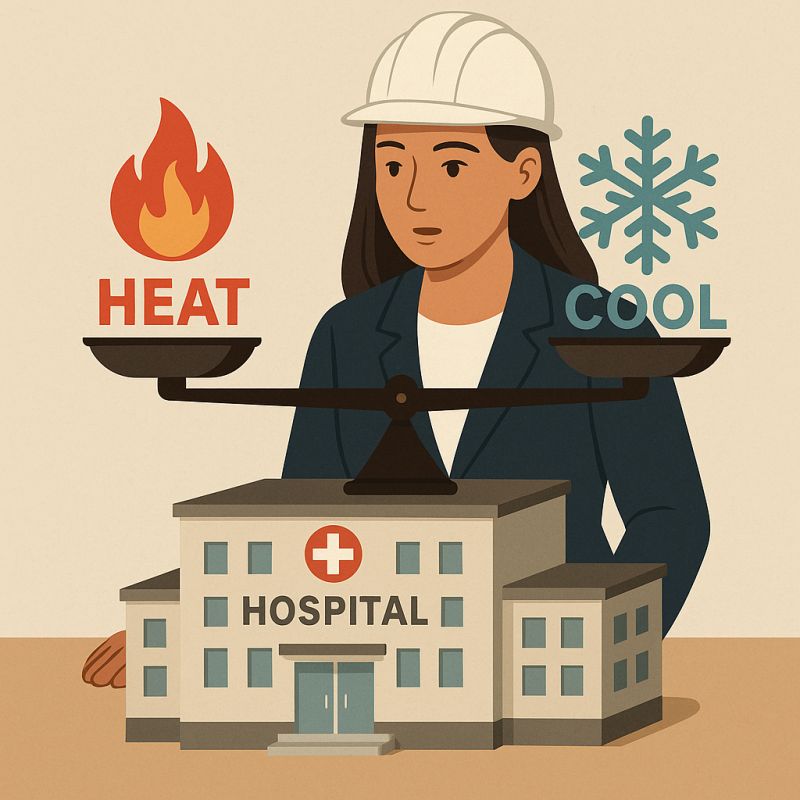
Geothermal will always work better than air and water source heat pumps for hospitals – here’s why.
Hospitals in the UK and Ireland face a huge challenge in reducing energy bills and their emissions footprint at the same time. Big air source heat pumps, or water source where there is a river, lake or sea nearby, are an attractive solution.
But these systems are limited by the fluctuations in temperature of the source, with lowest temperature when heat demand is highest, and highest temperature when cool demand is highest.
Geothermal exchanges for large unit heat pumps have steadier temperature and can act as both a supply and sink for thermal energy. Air and water exchangers can’t do that. So geothermal efficiencies (SCOP) will always be higher than air and water, 30% or more higher.
That’s important, because the electrification of heat needs to be ultra-efficient, using as little electricity as possible, as our electricity generation, transmission, and distribution infrastructure just isn’t up to the task of meeting a like for like conversion from gas to electricity. WIth geothermal an efficiency of 6 units of heat for one unit of electricity is possible.
In retrofit situations, hospitals with 5:1 or more ratios of heat:cool can also benefit from higher temperature, deeper geothermal heat where it’s available and viable.
In new build hospitals, where building efficiency leads to lower heat loads and more balanced heating and cooling, shallow geothermal exchanges, acting as seasonal thermal batteries, will be the go-to option.
Curious how this might apply to your facility? Drop me a note.
#energytransition #geothermal #hospitals #heatnetworks #heatpumps #heatishalf