Deep Geothermal isn’t a temperature problem. It’s a flow problem.
Posted on Tuesday, March 31st, 2026
Posted on Tuesday, March 31st, 2026
A lot of deep geothermal discussions start with temperature.
“Hot rock.”
“High temperatures.”
“Drill deeper and things must get better.”
But commercially, the key question is much simpler:
How does the heat reach the wellbore?
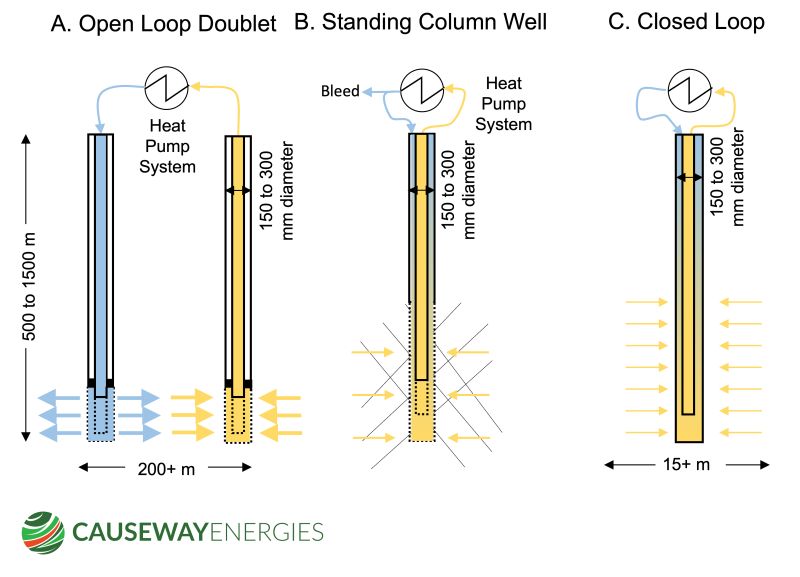
If a system relies on conduction through rock (as closed-loop systems largely do), the rate of heat transfer is limited by the thermal conductivity of rock, which typically varies only modestly, around 1 to 5 W/m·K.
In practical terms, that means the conductive heat supply to a wellbore is relatively small, e.g. ~100 W per meter of borehole.
Now compare that with fluid flow in an open-loop system.
A modest geothermal flow of 10–50 L/s, with a temperature drop of around 20°C, can deliver 0.8–4 MW of thermal power.
That’s four to five orders of magnitude more energy reaching the surface.
Not because the rock is hotter. But because moving water transports heat far more effectively than conduction through rock.
Which is why permeability matters so much and why open loop systems, harnessing either natural hydrothermal reservoirs, or permeability enhanced by engineered stimulation, are very often better for deep geothermal heat extraction.
It shows up in levelised costs too. One Causeway Energies deep geothermal research project (link in comments) showed how open loop geothermal can compete with fossil gas. Closed loop just needs far too much expensive wellbore.
Temperature tells us the heat is there.
Thermal conductivity governs how heat moves through rock.
Permeability determines whether we can deliver it at a commercial scale.
In geothermal development, the real subsurface challenge is often not finding heat.
It’s moving it.
#geothermal #energytransition #districtheating #cleanheat #subsurface