It’s easy to get geothermal heat projects through the feasibility stage in the UK. Making them bankable is the challenge.
Posted on Monday, April 13th, 2026
Posted on Monday, April 13th, 2026
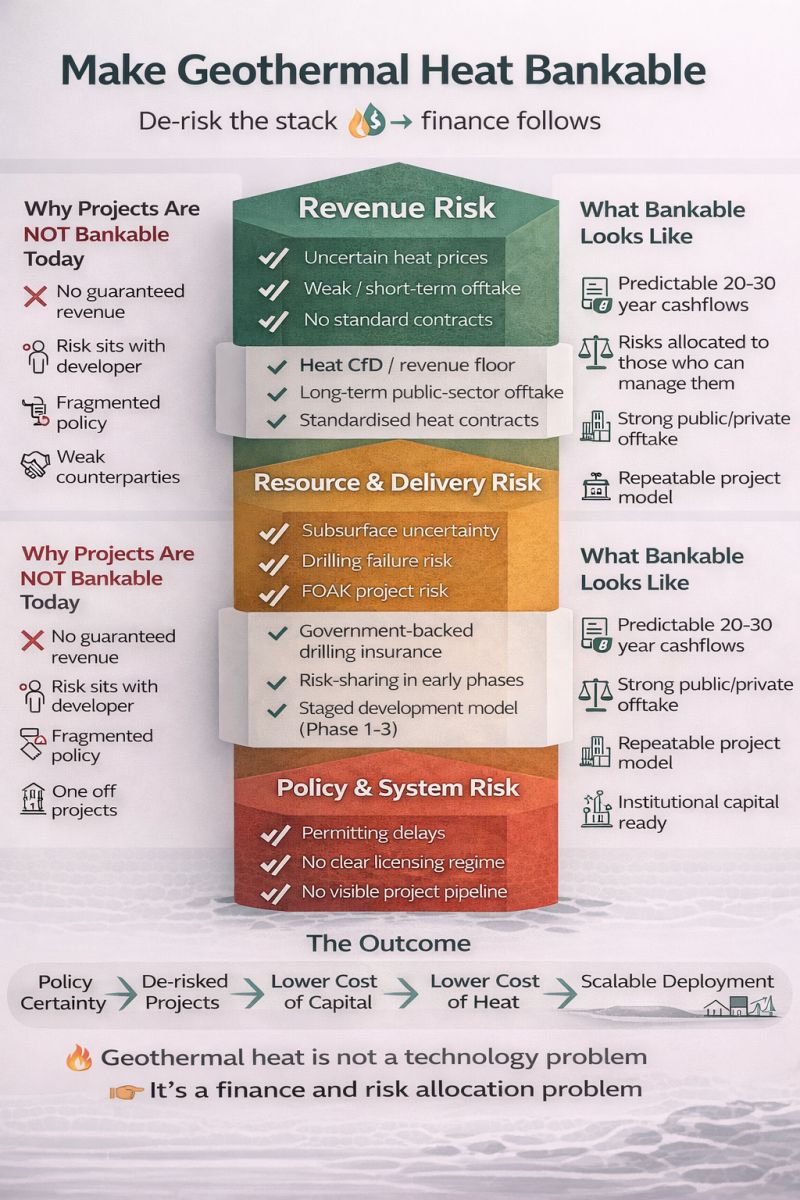
It’s easy to get geothermal heat projects through the feasibility stage in the UK. Making them bankable is the challenge.
The EIC’s Bankable Energies Report 2026 helps explains why – without ever mentioning geothermal. The report (link in the comments) divides the transition into “electrons vs molecules.” Electrons (wind, solar, batteries) are bankable: CfDs work. Molecules (hydrogen, CCUS) are stuck: no offtake, no cross-chain risk backstop.
In my view geothermal heat is a much more scalable opportunity than hydrogen or CCUS. But it shares the same problems, plus one the report doesn’t really address: pre-FID resource and FOAK risk/uncertainty. Capex for geothermal projects can run to 20% of the total spend before FID and bankability.
Geothermal heat projects can be technically viable. The resource is there. The economics can close. But they fail every debt finance test: no contracted revenue, a chequered UK track record (yes, I said it, geothermal has a reputational problem), and a single well result that can ruin the deal.
What would actually make it bankable? Drawing in part from the EIC’s own framework:
1. A Heat Delivery Contract – the CfD equivalent for heat. Without some kind of offtake agreement, everything else is difficult. Government can help by steering the public sector to procure heat as a service.
2. A licencing/permitting scheme giving developers exclusive rights to the resource and their data matters and a clear and timely patchway to execution. This may be subordinate to the heat contract, and any geothermal licensing scheme must recognise it is not resource-based petroleum or minerals exploration. Geothermal is “place-based” – focused on meeting the demands of the facility or network.
3. A resource/FOAK risk backstop: concessional capital or partial guarantee covering subsurface risk and uncertainty reduction. The EIC makes this case for CCUS cross-chain risk. The logic is similar for geothermal. Smaller entrepreneurial SMEs – the disruptors in this fledgling industry – particularly need that cover (yes, I’m speaking for a friend or two 😉). I think we may be able to get this started without government assistance, but analogues from Europe are there for copy and paste.
Although it’s clear that geothermal needs policy support to scale, I believe that it’s up to the industry to make government prioritisation of geothermal easy.
We need to deliver some flagship projects that send the signal to all that geothermal is scalable infrastructure, forming a material part of the energy transition.
#GeothermalEnergy #HeatNetworks #EnergyTransition #Bankability #CleanHeat #UKEnergy