How heat transfer works in the Fervo Enhanced Geothermal System technique.
Posted on Wednesday, May 20th, 2026
Posted on Wednesday, May 20th, 2026
I’ve been itching to understand how heat transfer works in the Fervo Enhanced Geothermal System technique.
A recent post by Fervo gives a lot of the answer.
For years, one of the big unknowns in enhanced geothermal has been what actually happens in the reservoir over time.
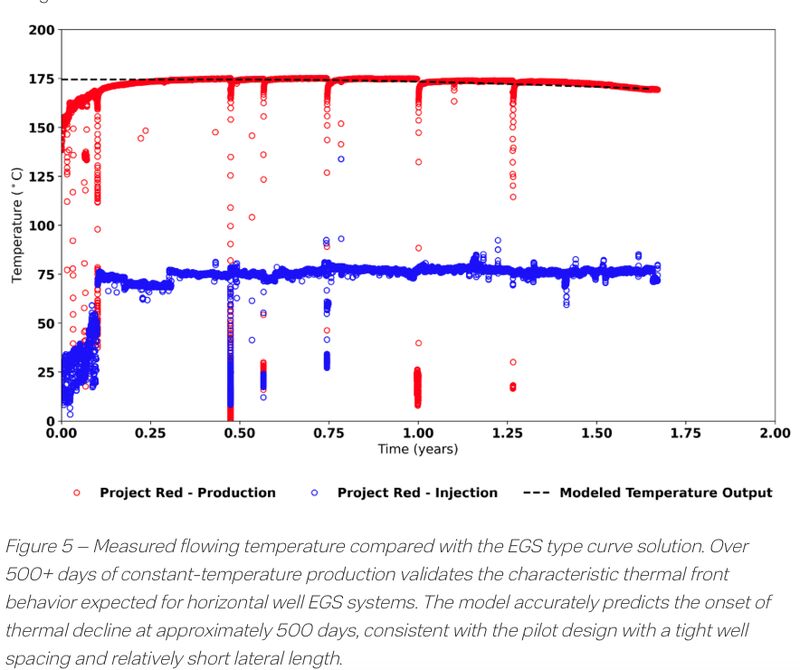
The latest production data from Fervo Energy (see link in the comments) is important not because it proves EGS technically works – we already knew that – but because it sharpens our understanding of how it works at scale.
And in my view, there are two really significant takeaways:
👉 First: advection is doing the heavy lifting.
This isn’t a slow, diffusive heat system. The data shows that water is cycling efficiently through the fracture network, in less than 24 hours, transporting heat via advection. That’s a step change in confidence – it tells us we can engineer flow paths that actually move heat at commercial rates.
👉 Second: decline is now a geometry problem, not a mystery.
Once you accept advection dominates, performance becomes governed by:
fracture surface area (how much rock you can sweep), and
conduction from the surrounding matrix (how quickly heat recharges those fractures).
In other words, decline isn’t some unknowable subsurface risk, it’s a function of designed fracture network + accessible heat volume.
👉 Third: this is oil & gas thinking, applied properly.
We’re moving from “is there a resource?” to “how do we engineer and manage it over time?”
That’s a very different mindset and a much more scalable one.
For me, this is the real milestone.
There’s much more to learn of course. How will wider spacing of producer and injector work? Will there be wider convection forces at work? What will be the real shape of the thermal decline curve?
And I remain skeptical of the EROEI dynamics of the Fervo value proposition and I really can’t imagine deployment at industrial scale outside remote areas with geography like the high desert of the western United States. Nevertheless I also keep wondering why there isn’t a fast following looky-likey in the footsteps of of Fervo.
But as a technology to watch, say for future more modest application for heat, Fervo’s efforts are exciting to watch and they to be congratulated for releasing the data to engage and inform us.
#Geothermal #CleanHeat #EnergyTransition #Subsurface #EGS #Infrastructure