The three processes that determine whether your geothermal project works… or doesn’t.
Posted on Thursday, June 4th, 2026
Posted on Thursday, June 4th, 2026
The three processes that determine whether your geothermal project works… or doesn’t.
Conduction. Advection. Convection. They work at scales from the local borehole, through the geothermal field, to the wider region. They’re not interchangeable, and which one dominates your reservoir dictates everything from well spacing to LCOE/H.
Conduction is the baseline – heat diffusing through rock at ~10⁻⁶ m²/s. Useful for understanding the resource. Painfully slow for extracting it. In unfractured basement, it’s essentially all you have. That’s why EGS enables advection by manufacturing permeability. Take for example the Fervo multistage hydraulic fracturing borrowed directly from unconventional oil and gas, targeting 10⁶–10⁷ m² of rock-fluid contact to outrun a process that naturally moves 5–6 metres per year.
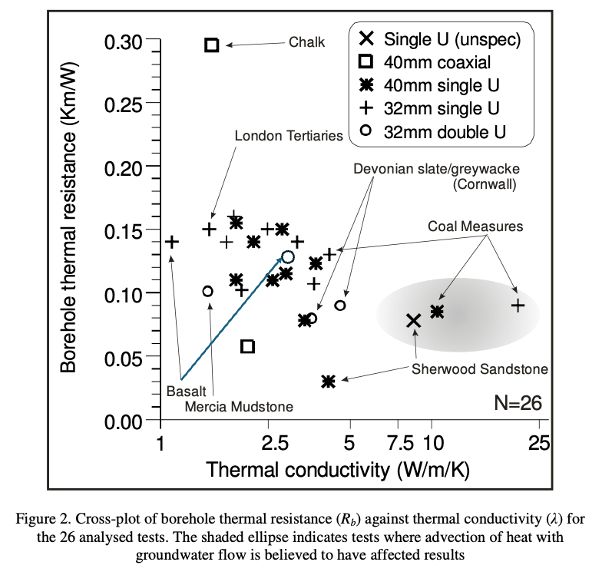
Even in shallow closed-loop GHP systems – classically treated as purely conductive – groundwater flow changes the picture. Advection past a borehole heat exchanger acts as a continuous replenishment conveyor, suppressing thermal depletion (see the picture). Field data show effective thermal conductivity increasing by up to 10x under induced groundwater flow. Seemingly frequently undervalued in system design, but that might be the right approach if the groundwater flow is not fully understood.
Standing column wells make the advection enhancement of conduction deliberate. By bleeding a fraction of flow during peak demand, they induce forced advection from the surrounding formation and stimulate convective replenishment from depth – actively managing heat transfer regime in response to load. In fractured rock with reasonable hydraulic connectivity, the performance uplift over conventional closed-loop is substantial.
At province scale, convection and advection appear to have a significant, but not well understood, impact on the overall resource quality. Fervo have distinguished conductive systems from convective systems,
Conductive are dry rock, no wet fractures to convey natural convection.
Convective is what nature does with enough permeability and a temperature gradient. Buoyancy-driven cells redistribute heat across tens to hundreds of kilometres, creating the anomalies that define exploitable plays. A special play to look out for in the UK and Ireland – think Bath/Bristol hot springs systems, for example.
The regime boundaries are set by permeability – the same master variable that drives everything in petroleum geology. The points of analysis are similar: dual-porosity exchange, sweep efficiency, breakthrough prediction, tracer testing. Different timescales, different commodity – same governing equations.
All geothermal systems, of whatever type, need to consider these processes in detail to ensure system design is optimised for sustainable commercial performance.
#GeothermalEnergy #CleanHeat #EnergyTransition #SubsurfaceEngineering #GeothermalDevelopment #Decarbonisation #EnergyInnovation