Why we shouldn’t lead with Early Carboniferous Limestones for intermediate to deep geothermal heat in Ireland and the UK.
Posted on Monday, July 6th, 2026
Posted on Monday, July 6th, 2026
Why we shouldn’t lead with Early Carboniferous Limestones for intermediate to deep geothermal heat in Ireland and the UK.
I’ve noticed that several current projects in the public sector look to be about the Early Carboniferous Limestones play. So I’ve been delving into what we know and, more importantly, don’t know about the ECL play.
Headline numbers in BGS assessments: 1,400+ EJ heat in place, prospective thermal power in the hundreds of GW.
The heat is real. The question is whether you can produce it. So far, no UK or Irish well has demonstrated commercial flow from deep ECL. (If I missed one, let me know).
The shallow aquifer literature is revealing – why should we expect deeper to be better in terms of productivity?
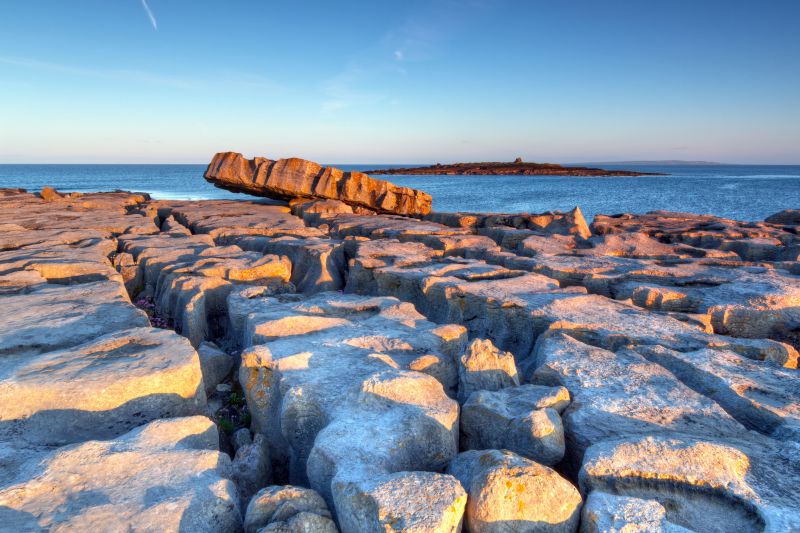
ECL matrix porosity is typically 1 to 2 percent. In the Welsh Pembroke Limestone Group, effective porosity drops from 6-8 percent in the upper 10m to 0.5-2 percent below that. Burial to 3,000m won’t improve that.
All meaningful flow is fracture or conduit controlled.
The Irish drilling record is sobering. GT Energy’s NGE1 well in Newcastle, Dublin (2008) found fluids in just two fractures at 1,400m. GSI’s Grangegorman well (2021) returned only a low-pressure artesian flow at around 800 m, not a tested productive interval. We do have the Moore & Walsh insight showing productive groundwater flow in Irish ECL is dominated by young Cenozoic strike-slip faults with karst overprint, not the older Carboniferous structures. Both their conductivity and the karst that enhances it decay rapidly below the top few hundred metres.
Balmatt in Belgium is the closest operating analogue. Production index 1.1-1.4 L/s/bar, injection index 0.4-0.5 L/s/bar, ML 2.2 felt seismicity in 2019, project suspended under the traffic light system.
Compare the Permo-Triassic Hot Sedimentary Aquifer. The West Esplande Well in Southampton has been produced geothermal heat from Sherwood Sandstone at ~1,800m from 1986 for a couple oof decades at least. Porosity 15-30 percent, intergranular flow, no fracture-dependency lottery. Indeed the Sherwood’s dual porosity behaviour may not be a bug but a feature – slowing thermal decline after initial breakthrough. UK and Irish Permo-Triassic doublets can target 20-60 L/s without stimulation.
ECL is a high-variance, sweet-spot-dependent play with pre-FID capital costs of £5m and 3+ year timescales from seismic to FID. Underwriting that against public spending and private equity capital is a structural problem.
If we want geothermal at NHS and public sector scale this decade, we should lead with the play that has predictable resource, better flows and financeable risk. ECL may be a real prize, but it’s not the front door.
#Geothermal #DeepGeothermal #Hydrogeology #DistrictHeating #DecarbonisingHeat